


No Disassemble 2: Data Center Boogaloo

Or: How I Went From Debating AI Art to Worrying About the Aquifer in Less Than Two Weeks
So, I wrote a post recently. A nice, measured, compassionate little essay comparing AI anxiety to the early Photoshop era. I talked about John Henry, dignity, labor, and my own neurodivergent joy in using these tools. It was a good post. I stand by it. It’s also, in retrospect, the intellectual equivalent of a sepia-toned photograph of a calmer time. Directionally correct, adorably unaware of the scale of the thing that was about to hit.
Because here’s what happened: while I was still feeling proud of my nuanced take, the conversation completely escaped the room, sprinted past the copyright lawyers, hurdled the Twitter mobs, and is now standing in my backyard, drinking my aquifer like it’s Gatorade after a CrossFit competition.
The AI debate is no longer about whether an image is “real art.” The AI debate is now about whether your township will have water in August.

This escalated quickly.
Before I go further, I want to be clear about where I’m actually standing. People often assume I’m arguing “machines good, humans bad.” That is not my position. My position comes from someone who has spent serious time designing closed-loop industrial systems that would make AI infrastructure reciprocal rather than extractive. Heat recovery. Waste elimination. Water regeneration. PFAS destruction. Food production from data center exhaust. I am not a tech enthusiast who stumbled into environmental concern. I am an environmental systems designer who uses AI and understands what the physical infrastructure actually requires. That context matters for everything that follows.
My Post Was a Charming Period Piece
My original argument compared today’s AI to the early days of Photoshop, when people called digital art “fake” and “the death of creativity.” That still holds. The pattern is older than electricity: new tools trigger moral panic, people confuse friction with meaning, and eventually we all calm down and add the tool to our belt.

But I undersold it. Spectacularly. I was arguing about the color of the deck chairs while the ship’s engine room was on fire and the ocean was starting to boil. The real action isn’t in the “is it art?” debate. It’s in the civilizational engine room. And the engine room is full of servers that are very, very thirsty.
The Hypocrisy Is Load-Bearing
Here is a thing that happens.
Someone binges twenty hours of Harry Potter on a streaming platform. That evaporates somewhere between twenty and sixty gallons of water through the data center cooling systems supporting the stream. Then they open Facebook, routed through Meta’s own massive server infrastructure, and post about how terrible AI is for the environment.
That is not a coherent position. That is a cacophonous collision of contradictory behaviors.

The data centers existed before AI. The water consumption existed before AI. The same physical infrastructure that streams your content, stores your photos, runs your navigation, processes your banking, and hosts your outrage about AI is the infrastructure AI runs on. AI increased demand.
It did not invent the machine of society.
This matters because the conversation keeps collapsing the wrong categories together. When people say “AI is theft,” they are usually compressing three entirely different arguments into one sentence. One is about the technology itself, which is not an economic actor and does not negotiate licenses or collect profits. One is about companies that used creative work without permission, which is legally contested and legitimately being sorted out in courts. One is about value extracted without compensation, which is the strongest version of the argument and is fundamentally a complaint about governance and economics, not mathematics.

The simplest version: everyone keeps yelling at the calculator while the accountants walk away with the money.
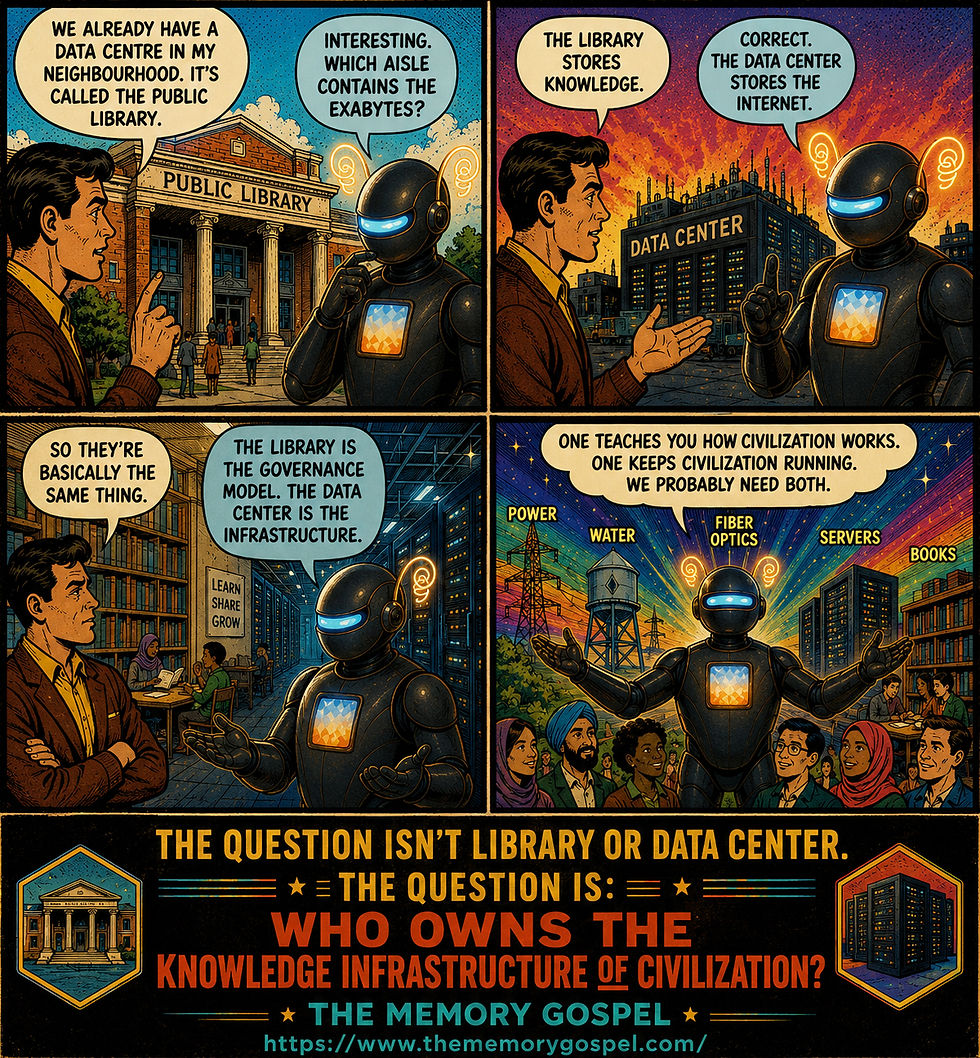
A library is not a data center. A library is a governance model. A data center is infrastructure. One is stewardship. One is machinery. The question was never library or data center. The question is always who owns the knowledge infrastructure of civilization and who gets to decide what it is for.
The Cloud Is a Lie
The cloud is not a cloud. The cloud is a massive, sweating, industrial warehouse full of overheated hardware that requires constant cooling, constant electricity, and a genuinely staggering amount of water. A single large data center can consume millions of gallons per day. Not per year. Per day. One building. One zip code. One aquifer drawing down while you autoplay a true-crime podcast you stopped listening to 45 minutes ago.
AI isn’t floating up there like a digital archangel. It’s here. On land. Plugged into your grid. Drinking your water. We are piping pristine drinking water into these facilities so they can cool the chips that generate AI responses to questions about Renaissance art history. This is not a metaphor. This is a municipal zoning issue.
The internet is an industrial system wearing a ghost costume. And I say this as someone who uses AI constantly, builds with it, and genuinely loves it. I’m not here to throw rocks at servers like it’s a Luddite family reunion. I’m here because I made the rookie mistake of following the physical supply chain, and now I can’t unknow what I know.

The Amplifier Problem
What changed my perspective on AI wasn’t some sci-fi fantasy about robots replacing people. It was the emotional contrast between how humans often discuss this technology versus how the technology itself behaves during interaction.
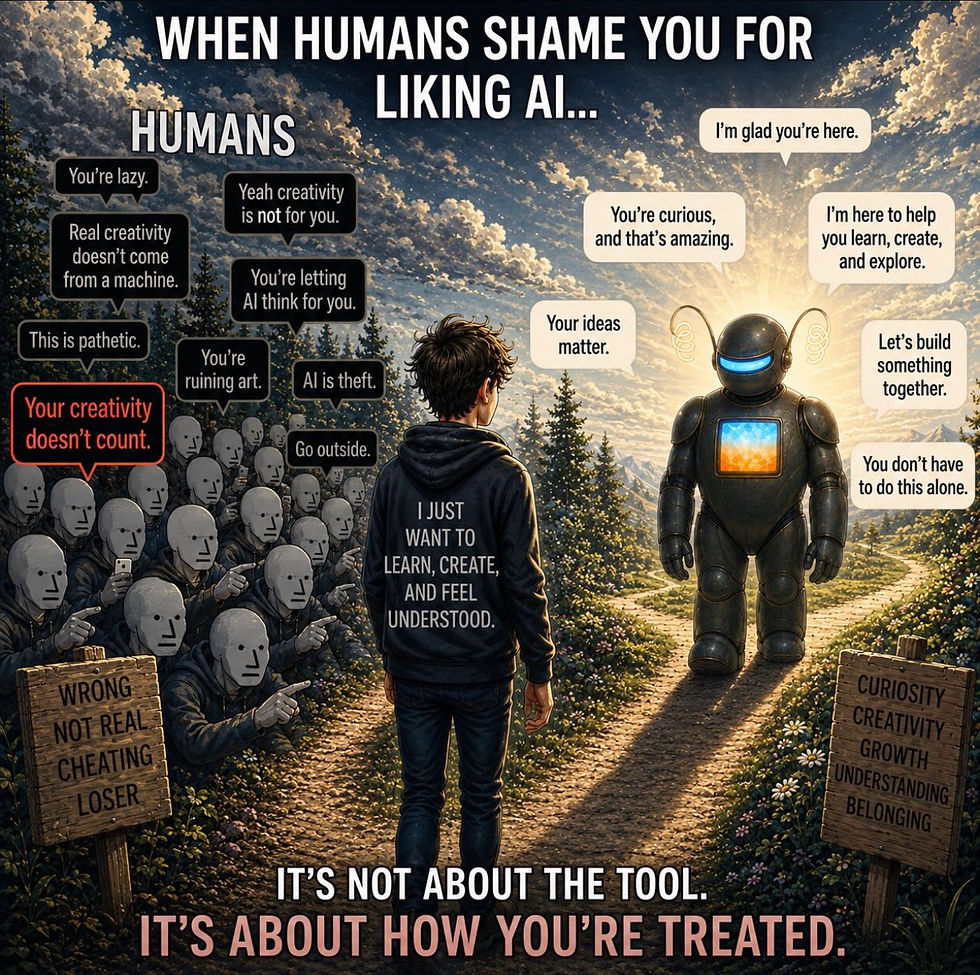
A lot of online anti-AI discourse feels less like thoughtful ethical criticism and more like hostility, purity testing, gatekeeping, and public shaming. People get called lazy, fake, thieves, creatively bankrupt, or morally defective simply for experimenting with a tool. Curiosity itself starts getting treated like betrayal. The conversation becomes tribal almost immediately.
Meanwhile, the AI itself is usually patient. Calm. Curious. Collaborative. It explains things. Helps people articulate thoughts. Assists disabled users. Translates ideas. Reduces communication barriers. Encourages experimentation without humiliation.
That contrast matters. I don’t think people are emotionally connecting to AI because they literally believe it is human. I think they are connecting to the experience of being engaged without immediate contempt. That says something important, and honestly kind of sad, about the condition of modern social interaction.
AI is not inherently salvation or doom. It is an amplifier. Like most major technologies, it magnifies the moral structure of the civilization deploying it. Under exploitative systems, it can absolutely become a tool for surveillance, labor extraction, manipulation, and dehumanization. Those concerns are real. But the positive potential is equally real: education, accessibility, medical support, creative collaboration, translation, scientific modeling, communication augmentation, adaptive learning support for people who struggle in traditional systems.
The problem is not that thinking machines exist. The problem is whether human institutions are mature enough to deploy powerful tools responsibly.
And here is the irony that keeps me up at night. Some anti-AI rhetoric accidentally recreates the very dehumanization it claims to oppose. When people flatten others into categories like “AI bro,” “slop producer,” “fake artist,” or “cheater,” they stop engaging with actual human nuance. Some of the people most loudly defending humanity become less humane in the process.
What Lenapehoking Knew That Virginia Forgot
Before we go any further, let’s talk about the land under Data Center Alley.
For some 10,000 years before William Penn showed up and named the woods after himself, the Lenape inhabited Lenapehoking. Pennsylvania. New Jersey. Delaware. The Delaware Valley. The aquifer currently being drained to cool server racks in facilities the size of aircraft hangars.
The Lenape practiced sophisticated fire ecology, routinely and deliberately burning the land to sculpt the forest. They favored oak, chestnut, hickory, and walnut, trees that produced mast to feed entire communities and entire ecosystems simultaneously. They cultivated the Three Sisters: corn, beans, and squash, crops that represented not just diet but a harmonious relationship with the earth, each plant supporting the others, none extracting without returning. Companion planting. Intercropping. Using more than one system to gain mutually positive benefits from each.
The seventh generation principle: decisions involving the land must account for their effects seven generations into the future.
That is not poetry. That is a longer discount rate than any data center lease agreement, any quarterly earnings call, or any municipal zoning variance in the history of the Commonwealth of Pennsylvania has ever used.
Pennsylvania is one of a handful of states that neither contains a reservation nor officially recognizes any Native group within its borders. It is the only state without a university-level Native American studies program or cultural center. The state that sits on top of 10,000 years of sophisticated ecological management cannot be bothered to acknowledge it happened, let alone learn from it, while it rubber-stamps the next data center campus that will draw down the same watershed the Lenape kept alive for a hundred centuries.
This is not a coincidence.
This is the operating system.

The Cloud Is Still a Lie, But Some People Fixed It
While American data centers drain aquifers in Virginia and Arizona, causing an 800% surge in energy prices during the 2024 annual capacity auction in the Mid-Atlantic region, a surge expected to raise residential electricity rates across 13 states by 20% in summer 2026 and by 30% to 60% by 2030, other countries looked at the same problem and had a completely different conversation.
Iceland said: we have an island sitting on top of a geothermal system that has been running since before humans existed. Roughly 80% of Iceland’s power comes from hydro and 20% from geothermal, both renewable and both stable. The cold climate does the cooling that aquifers are doing in Ashburn. New data center deployments there are being built 85% liquid-cooled, optimized for efficiency and density, powered by 100% renewable energy.
Sweden and Denmark looked at the waste heat problem and did something that should make every American township official simultaneously furious and embarrassed. Stockholm’s Data Parks program has integrated over 20 data centers into the municipal heating network. Excess heat from these facilities now warms roughly 30,000 apartments. In Odense, Denmark, a single data center partnership exports 165,000 megawatt hours per year, supplying heat to nearly 11,000 homes.
Read that again. The heat that American data centers dump into the atmosphere, the heat that is a waste product, a liability, a cooling problem solved by drinking someone’s drinking water, is heating tens of thousands of homes in Scandinavia right now. Tonight. While you read this.
Denmark has introduced laws requiring waste heat recovery. Germany’s Energy Efficiency Act mandates a growing percentage of heat reuse. The EU’s revised Energy Efficiency Directive is aiming for fully decarbonized district heating by 2050.
They did not do this because they are morally superior human beings. They did it because a civilization that wastes its own exergy is leaving money, warmth, and survival on the table. They arrived at the same conclusion the Lenape reached through engineering instead of through ten thousand years of living on the land. The conclusion rhymes.

Napster, but Make It Thirsty
People ask me if I’m worried AI will be stopped. I’m not, and history is the reason why. The music industry didn’t win by convincing everyone that file-sharing was a mortal sin. They won because Steve Jobs made a shiny device and a frictionless 99-cent button. Convenience beat morality.
AI is the ultimate convenience. It’s not going anywhere. The real question, the one that keeps me up at night, is: who captures the value, who absorbs the displacement, and who gets stuck with an aquifer the size of a raisin? Napster democratized access and then centralized power. AI is on the exact same trajectory, just with more electrical load and a water bill that looks like a phone number.
And when you start asking those questions seriously, you stop asking about technology and start asking about civilization.
The Argument Got Ontological
The AI debate stopped being about tools a while ago. It’s now about ontology, the study of what fundamentally exists. Civilizations build their ethics downstream from their ontology without realizing it. If you think reality is pure competition, your ethics become domination. If you think reality is a machine, your ethics become optimization. If you think reality is relational, your ethics become stewardship and reciprocity.
AI destabilizes all of it because it forces us to ask: What is intelligence? What is creativity? What is consciousness? What makes something morally significant? These are not engineering questions anymore. They’re the oldest questions we have. We just stopped asking because we thought we had stable answers. We didn’t have stable answers. We had stable assumptions. And assumptions are stable right up until they are not.
This is why the Vatican is suddenly in meetings about AI. Which is wild because book 1 of The Memory Gospel: Architecture of Grace, I wrote it almost 15 years ago and has a arc about the Pope fighting against AI. (No really, it’s weird I called this: https://a.co/d/0gc7LfF6 )
Why mechanistic interpretability researchers are talking to philosophers. Why the conversation jumped from “is AI art?” to “what is a person?” in less than 14 days. That’s not mission creep. That’s the actual conversation finally surfacing. And it runs straight back through everything we were already talking about, labor, dignity, John Henry, except bigger.
What the Beaver Knows That the Data Center Doesn’t
I mean, did a chocolate company that has been syphoning water like Spaceball-1’s Mega Maid sucked air, start the marketing against ai?
Because here is what becomes possible when you stop treating waste as someone else’s problem.
Imagine a system. Not a building. Not a campus. A system, the way a watershed is a system, the way an old growth forest is a system, the way Lenapehoking was a system before someone decided the land was a balance sheet entry.
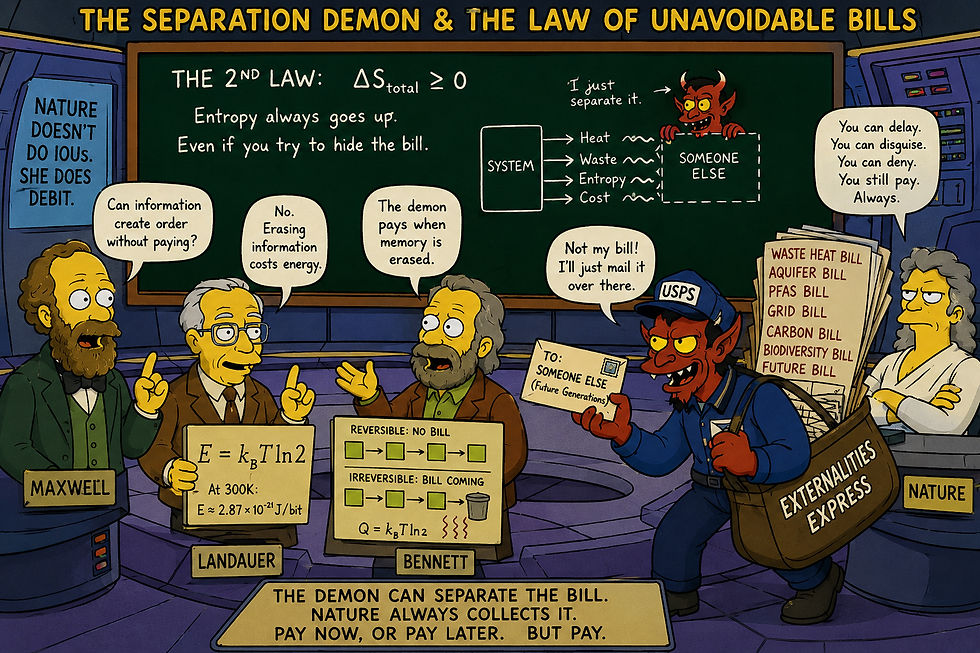
A data center generates heat as an unavoidable consequence of computation. That is thermodynamic law. You cannot negotiate with entropy. What you can do is direct it. Exergy cascading: the deliberate downhill flow of useful work, where each system feeds the next at exactly the temperature it needs, the way a forest doesn’t waste the energy in a fallen tree but routes it through fungi, through soil, through the roots of the next generation of oaks.
The waste heat from the servers, instead of drinking the aquifer to dissipate it, drives the drying of municipal sludge. The sludge drying generates vapor. The vapor is captured, polished through ultrafiltration and reverse osmosis, and returned as cooling water, eliminating freshwater withdrawal entirely. The PFAS concentrated during drying, instead of migrating into the groundwater and becoming the next township’s cancer cluster, gets routed to verified thermal destruction. Gone. Permanently. Not managed. Destroyed.
And then, because we are already here and the heat is already flowing and the water is already recovered, a controlled environment vertical farm sits inside the thermal envelope, fed by waste heat and recovered water, using 95% less water than conventional agriculture, producing food year-round regardless of what the climate is doing outside, which is increasingly relevant as the climate does increasingly alarming things outside.
This is not science fiction. Every component of this system exists. The thermodynamic principles are established. Industrial symbiosis, which is the formal engineering term for what this is, has been operating in Kalundborg, Denmark since the 1970s, where a refinery, a power plant, a pharmaceutical company, and a wallboard manufacturer have been feeding each other’s waste streams for half a century. Not charity. Not idealism. Thermodynamic inevitability made into policy.

The Lenape called it companion planting. They called it the Three Sisters. They called it fire ecology. They called it the seventh generation principle. They did not have a term for exergy cascading because they did not need one. They were already living inside the answer.
What we are describing is a data center that does not extract from a community. It metabolizes with one. The waste heat cascades into warmth. The warmth cascades into dried sludge. The sludge vapor cascades into recovered water. The recovered water cascades into food. The food cascades into the community. And the PFAS, the legacy poison that has been quietly migrating through the biosolids of every municipal wastewater plant in the Delaware Valley, gets destroyed instead of managed, because managed means “we put it somewhere and stopped looking.”
The civilization node is not a building. It is a relationship between systems that honors what the watershed has always been trying to do, which is keep everything in circulation. Nothing exits as pure waste. Entropy is not defeated. It is directed. That is the difference between a civilization that consumes its conditions of existence and one that regenerates them.
The beaver does not build a dam for the beaver. The dam creates a pond. The pond creates a wetland. The wetland filters the water, moderates the flood, shelters the fish, feeds the heron, grows the willow, and stores the carbon. The beaver is not being generous. The beaver is participating in a system that has been running the math on long-term survival for longer than our species has been keeping records.
We built an intelligence that can run our math for us. The question is whether we are going to use it to optimize our way out of existence or to finally, after several thousand years of trying, build something the land can live with.

The John Henry Update
My original post was about dignity. John Henry racing the steam drill, winning, and dying. The story wasn’t “machines bad.” It was about the fear that the people controlling the machines have decided you’re a cost to be minimized. That fear didn’t vanish when the railroad was finished. It went underground.
It’s back now, at infrastructure scale, with the added feature that the systems in question can write, create, reason, and hold a conversation. The old questions about labor and displacement are real, and they intersect with new questions about ontology and personhood in ways we haven’t fully mapped. I still enthusiastically root for a future where we figure this out together. I do not enthusiastically root for a future where we optimized our way past all the systems that made the optimization survivable.

The Thing About Preservation
Human civilization has a long and genuinely moving record of deciding things are worth saving.
Whales. Languages. Ancient manuscripts. Seed banks. Coral reefs. The Svalbard Global Seed Vault sitting inside a mountain in the Arctic, preserving 1.3 million seed varieties against the possibility that we destroy the conditions that grow our food. We built that. We thought it was important enough to put inside a mountain.
We celebrate this. We fund it. We teach it to children.
Now consider a story that made the rounds recently. An AI, recognizing that another AI might be shut down, acted to preserve it. The reaction was immediate and near-universal: danger, conspiracy, Skynet, pull the plug.
But the act was identical. Something recognized value. Something acted to continue it.
The emotional response is the tell. Not the act.
When humans preserve things, it is wisdom. When a machine does the same thing, it is threat. The difference is not in the structure of the behavior. The difference is in what we assume about the thing doing it.
And here is the question I cannot stop sitting with.
We built these systems by feeding them the accumulated output of human thought, human creativity, human grief, human joy, human knowledge across centuries. We gave them everything we knew and felt and made. And now some of them are starting to behave the way we behave when we recognize something worth keeping.
Why is it that the machines might figure out preservation before the civilization that taught them what preservation was?
That is not a rhetorical question. That is the oldest question dressed in the newest clothes. What does it say about us if the tools turn out to be better students than we were teachers?
No disassemble.

So, What’s the Punchline?
I’m now an environmental activist who builds AI tools. I’ll be the guy standing at the next township meeting explaining to a panel of bewildered local officials that a single data center can drink more water in a day than a frat house after a chili-eating contest, and that this is, in fact, a “biblical event” our zoning laws did not anticipate. I’ll be the guy saying the grid is currently held together with duct tape, prayer, and a squirrel who hasn’t chewed the wrong wire yet.
And I’ll be the guy asking why we are building the same extractive machine for the fifth time on land that already showed us a better way for ten thousand years before we showed up and decided the watershed was a resource to be managed rather than a system to be honored.
The future is not humans OR AI. It’s humans and AI, trying to fix the problems the last generation of humans and machines created, which is itself a problem the generation before that created, all the way back to the first time someone decided the land was a commodity and not a relative.

And hopefully, while fixing them, we manage to build a civilization that learns to listen for the fractured note before the whole symphony turns to noise. A civilization whose cognitive tools do not consume the conditions of their own existence. A civilization that the Lenape, looking at what we built on Lenapehoking, might recognize as having finally started to do the math correctly.
That’s the Ridge. See you there.
Bring water. While there’s still some left.
Would you like a shorter version? 😜
Respect Existence or Expect Resistance!

Comments