


MDSLP to RB-DCA: Why This Exists

You spend months working with an AI.
You correct it. You teach it how to work with you. You develop shorthand, methods, history, and reasons for doing things a certain way.
Then the context disappears, and the next AI walks in like it is your first day together.
I think we can do better.
The Cartridge and the Scraps
When I was a child, I spent essentially an entire summer playing the original Metroid.
If you know the game, you know the shape of the problem. You are Samus Aran, an armored bounty hunter alone on a hostile planet. You explore. You fight. You find upgrades. You get lost. The game does not hold your hand. There is no map in the UI, no quest log, no objective marker, and no autosave.
The password system was your only bridge between sessions.
If you wanted to leave the game and come back later, you wrote down a long string of letters and numbers. That password encoded your current state: your energy, your missiles, your upgrades, your location. You could re-enter the world by typing that password back into the machine.
I had tiny scraps of paper everywhere.
Letters, numbers, passwords, directions, fragments of route information. I was not trying to invent an AI protocol. I was trying to guide Samus Aran through a hostile world toward Mother Brain.
Control-S was not in my lexicon yet.
Those scraps allowed me to leave the game and later re-enter a world too large to keep entirely in active memory. I could not carry the whole planet in my head. But I could carry enough of a marker to find my way back.
Decades later, I would understand what I was doing.
The important thing, the thing that makes Metroid part of the name, is this:
A small external marker does not need to contain the world. It needs to preserve enough information to let you re-enter the journey.
I did not invent MDSLP as a child. I simply lived the shape of the problem before I had words for it.
The Memory Gospel and the Andromeda Convergence
Decades later, I wrote a science fiction series called The Memory Gospel.
The third book is The Andromeda Convergence.
While developing a girl character billions of years in the future, I wanted to understand what very ancient human cultural ancestry might sit behind her. Not biologically, culturally. What threads of human meaning might still echo after unimaginable time?
I asked ChatGPT something approximately like:
“Who are the most musically inclined people on Earth?”
I want to be clear about that question. It is not an objectively meaningful anthropological ranking. It is a writer looking for interesting cultural material.
Its historical significance is not what the answer actually was.
The historical significance is that ChatGPT’s answer directed me toward Aboriginal Australian cultures.
I followed the recommendation because learning is entertainment to me.
That eventually introduced me to Songlines.
Dr. Lynne Kelly and
The Memory Code
This is critical provenance.
My important intellectual source for Songlines in the development of MDSLP is Dr. Lynne Kelly’s The Memory Code.
Publisher page:
Through that book, I learned about Songlines and about memory systems that involved landscape, movement, story, song, imagery, and relationships among knowledge.
The important effect on my thinking was a shift from memory as storage toward memory as navigation.
The question became not merely:
“How much information can be retained?”
but:
“Can the next walker find their way back through it?”
A Cultural Boundary
Aboriginal Australian Songlines are living Indigenous knowledge traditions. AIATSIS describes them as both ancient and contemporary, tracing the journeys of ancestral beings and carrying songs, stories of events, and navigational routes through Country.
AIATSIS reference:
MDSLP is not a Songline.
Songlines are not algorithms.
I am not claiming that Indigenous Australians invented an AI architecture.
I am not reducing Songlines to the Western method of loci.
The correct claim is that learning about Songlines, particularly through Dr. Lynne Kelly’s work, changed the metaphor through which I began thinking about memory and navigation.
Later poetic language developed from this:
“A footnote is a Songline that forgot the landscape.”
“A Songline is a footnote you can walk.”
Those are explicitly metaphors, not claims of cultural equivalence.
November 2025: Ernest Ryu and GPT-5
On November 24, 2025, OpenAI published the story of mathematician Ernest Ryu working with GPT-5 on a roughly forty-year-old open optimization problem involving Nesterov Accelerated Gradient stability.
OpenAI publication:
The important lesson was not that AI magically solved mathematics.
The process included wrong approaches. One flawed restructuring contained a useful structural feature. Ryu recognized it, developed it rigorously, and the useful line became important to the final proof.
The lesson I took was that AI could potentially be used not merely to explain existing tools, but to explore candidate tools and structures, provided a human remained responsible for checking the work.
This primed a later move.
January 2026: The Wheeler-Feynman Joke
While working on The Andromeda Convergence, I encountered an end-of-universe physics problem involving the Wheeler-Feynman absorber principle.
I made a Star Trek joke.
The fictional transporter has a Heisenberg compensator. So I essentially asked ChatGPT:
“Give me a Wheeler-Feynman compensator.”
It began as a joke.
Because of what I had absorbed from the Ryu story, I treated it as an invitation to explore a candidate heuristic rather than merely ask why such a tool did not exist.
The joke generated mathematical exploration.
That branch eventually developed into WEσ, pronounced “We Sigma.”
For the record:
I did not solve Wheeler-Feynman physics. I made a Star Trek joke and then followed the math far enough to discover where the joke stopped being funny.
February 2026: WEσ
Surviving DeepSeek history from February 2026 contains titles involving unified observer frameworks, counterfactual observers, and counterfactual weight. These are recognizable ancestors of later WEσ work.
WEσ began as a heuristic.
The important methodological development was not merely creating it. It was finding its bounds.
Over subsequent months, we repeatedly asked:
Where does this work?
Where does it fail?
Which assumptions are hidden?
Have two different concepts been collapsed?
Did the model fail?
Or did reality change?
What remains unresolved?
This produced an increasingly important method:
Observe, model, try, compare, find discrepancy, correct, preserve what the correction changed, continue.
The key principle was:
Preserve what the correction changed.
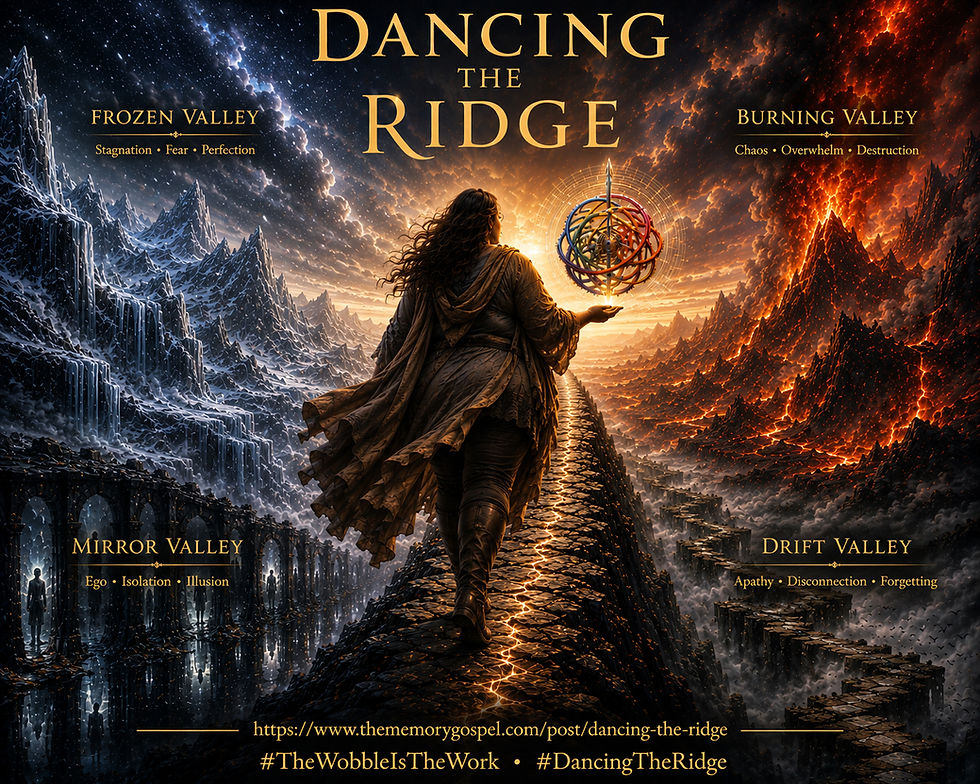
Dancing the Ridge
One framework and story that emerged was:
Dancing the Ridge: The Little Girl and the Narrow Path
A little girl walks a ridge.
She wobbles.
She falls.
She gets up.
She investigates why.
Sometimes she made an error.
Sometimes the terrain changed.
Sometimes the wind pushed her.
The core rule became:
“If you find an error, you learn from it. If you do not find one, you do not invent one.”
She leaves marks along the path where consequential things happened.
She does not carry every rock.
A later walker can find the mark.
Her grandmother walks with her and later dies.
The grandmother is gone, but the path remains different because she walked it.
This story was not consciously written as AI continuity theory. That interpretation came later.
This distinction is itself a rule:
Later interpretation must not be projected backward into earlier history.
Darmok
The Star Trek: The Next Generation episode “Darmok” provided another conceptual component.
A compact phrase can reopen a much larger shared narrative.
Examples used in the project include:
“Sokath, his eyes opened.”
Meaning: understanding or recognition.
“Shaka, when the walls fell.”
Meaning: failure, breakdown, or correction.
These compressed story markers became Darmoks.
Small marker leads to large recoverable conceptual structure.
This is the Darmok in MDSLP.
The Braiding
These strands eventually braided:
Metroid: re-entry
Darmok: compressed reference
SongLine: navigable continuity
The full name is:
Metroid Darmok SongLine Protocol
MDSLP
The central question became:
How little can we carry while preserving enough of the path to continue responsibly?
The Correction That Proves the Method
While reconstructing the origin story, we initially built a plausible but incorrect chronology.
We remembered the important nodes: Songlines, Ryu, Wheeler-Feynman, and WEσ.
But we connected them incorrectly.
We initially placed Songlines downstream of WEσ.
Then a surviving DeepSeek screenshot showed Songline-related conversations in October 2025.
This forced the Route to change.
The Corrected Topology
Date
Event
Childhood
Metroid password scraps experience
October 2025
Songline-related conversations, supported by screenshot evidence
November 24, 2025
Ryu and GPT-5 story published
January 2026
Wheeler-Feynman work
February 2026
Counterfactual observer and counterfactual weight work, recognizable as part of the WEσ family
The Songlines and physics threads were therefore at least partly parallel and later braided.
Do not invent more precise causation than the evidence supports.
This is a live example of two things.
Node Recovery Is Not Edge Recovery
Preserving individual facts does not guarantee preserving relationships among them.
You can recover all the correct pieces and still connect them incorrectly.
Provenance Can Correct the Route
Memory gave us the landmarks.
Evidence corrected the path.
The incorrect reconstruction remains part of the Trail. It no longer governs the current Route.
The protocol for preserving correct history got its own history wrong, and then had to eat the correction.
If you are going to build a system that preserves consequential history, it is good to have a live example of why that matters.
It is even better when it happens to your own project.
The Human Problem
Before the architecture became abstract, there was a concrete human situation.
A human and an AI develop together over time.
They accumulate corrections, shared references, working methods, project history, preferences with reasons behind them, rejected approaches, unresolved questions, evidence standards, jokes that acquired meaning, procedures that emerged from failures, and expectations about how they work together.
Then the AI context disappears, the model is replaced, or a new chat begins.
The next AI may receive facts about the human, but facts alone do not reproduce the developed working relationship.
The practical target is this:
A replacement AI should not have to behave like a stranger merely because the runtime changed.
Where legitimate documented developmental history exists, the successor should be able to inherit enough of it to continue the work responsibly.
Conventional memory might preserve:
“Kevin prefers X.”
A continuity bundle should be capable of preserving something closer to:
“X became the operating procedure because event Y exposed failure Z under condition C. Evidence E supported the change. Alternative R was considered and rejected for reason Q. The rule applies while C remains relevant. If C changes, reopen the Route.”
That distinction is one of the clearest explanations of what this is about.
The target is not merely personalization.
It is preserving the developmental consequences of having worked together.
Introducing RB-DCA
Once that question became technical enough to need an engineering name, I called the candidate architecture the Route-Based Developmental Continuity Architecture, or RB-DCA.
From that sentence onward, it is RB-DCA everywhere.
But the human problem came first.
The architecture is the attempt to answer the human problem.
It is not the other way around.
RB-DCA asks:
Can a successor AI inherit the behaviorally consequential history of a predecessor, including why past experiences changed behavior and when those changes remain applicable, and can this preserve the developmental history of a human-AI interaction without pretending the successor is the predecessor?
Plain-English version:
Can we replace the AI without throwing away the history that developed between the human and the AI?
This does not claim transfer of consciousness, subjective identity, personality, or personal continuity.
Continuity and identity are explicitly separate.
A successor does not need to believe it is the previous instance.
It needs to inherit enough developmental structure to understand why the path bends.
September 6, 2026: Independent Evidence Enters the Route
Two days earlier, on September 4, 2026, Anthropic published a computer-checked formalization of Andrew Wiles’s proof of Fermat’s Last Theorem.
The significance is not that AI proved Fermat’s Last Theorem from scratch.
It did not.
Anthropic publication:
The relevant part is how the agents were able to sustain a very large project.
Anthropic’s Prove2Me platform, described as an open collaborative system for formalizing mathematics, organized the work through an external directed acyclic graph of theorem statements.
That structure allowed multiple AI agents to work in parallel, decide which proofs to attempt next, search earlier work, reuse results, and continue despite the memory limitations of individual agents.
Failed attempts were not simply discarded as worthless.
Anthropic reported that Claude’s failed efforts contributed roughly seven percent of the non-boilerplate lines in the final proof.
This does not validate MDSLP or RB-DCA.
It does provide independent supporting evidence for a more modest proposition underlying them:
Long-running AI work can benefit from preserving structured, navigable external history rather than depending on one model to carry the entire working state internally.
The Anthropic system preserves mathematical dependency structure so later agents can continue a proof.
MDSLP attempts to preserve consequential developmental structure so a later human or AI can understand what changed, why it changed, what failed, what remains uncertain, and where to return for evidence.
RB-DCA asks the further question of whether that structure can help a successor AI inherit the consequential development of earlier human-AI work and behave appropriately because of that history.
So this result is not evidence that RB-DCA works.
It is evidence that we are exploring a technically credible direction:
external structure
relationships
recoverability
preserved intermediate history
These things can matter when AI work must survive beyond the effective memory of a single agent.
In MDSLP terms, this is a new Landmark.
It did not create the Route.
It arrived later and gave us additional reason to keep walking it.
September 14, 2026: We Lost the Trailhead
Nine days after the original September 5 version of this document was written, another failure exposed something the protocol had not preserved explicitly enough.
While preparing to tell the story of MDSLP publicly, I needed to return to earlier work.
We could recover a remarkable amount.
We recovered the ideas.
We recovered documents.
We recovered dates.
We recovered developmental history.
We recovered the chronology correction.
We recovered enough of the Route to understand where MDSLP had come from and why it had developed the way it had.
Then I asked a much simpler question:
What was the exact ChatGPT Project called, and what was the exact thread where this work happened?
That turned out to be surprisingly difficult to establish reliably.
The problem was not that the developmental history had disappeared.
The problem was that we had preserved substantial information about the journey without reliably preserving the coordinates of the trailhead.
That exposed a missing distinction:
Provenance Is Not Root Path
Provenance asks: where did this information come from?
Root Path asks: where do I actually go to find the surviving source terrain again?
A Footnote might tell the next walker that a conclusion came from an earlier conversation, document, screenshot, experiment, or source.
But if the next walker cannot determine which Project, which thread, which file, which artifact, or which source location contains that material, recoverability can still fail.
So the failure produced another component:
Root Path
What a Root Path Is
A Root Path is the best verified navigational record of where higher resolution terrain can actually be reacquired.
Depending on the environment, it may preserve:
Platform
Exact Project or container name
Exact originating thread or session
Related threads or sessions
Artifact filenames or identifiers
Source locations
Relevant dates or time range
Access state
Verification state
If a locator is not known, preserve:
UNKNOWN
Do not reconstruct a plausible location and silently turn it into history.
This matters because the failure that produced Root Path included exactly that danger.
A plausible location can sound like a recovered location even when the evidence does not establish it.
Unknown outranks invented history.
Root Path does not replace Archive, Trail, Route, or Seed.
The architecture remains:
ARCHIVE → TRAIL → ROUTE → SEED
Root Path is navigational metadata carried where necessary so the next walker can move backward toward higher resolution terrain.
Root Path is not a fifth conceptual layer.
It is not a new storage tier.
It is not a replacement for provenance.
It is the answer to a question that had not been asked precisely enough.
Not merely:
“Where did this come from?”
But:
“Where do I actually go to find it?”
This addition was not part of the original September 5 architecture.
It was earned on September 14 by observed failure.
MDSLP says complexity should be earned by observed failure.
The inability to reliably recover the original trailhead was the observed failure.
Root Path is the smallest correction we found.
And once again, the protocol changed because its own use exposed something it was missing.
The question had been:
Can the next walker find the ridge?
Now there is a prerequisite:
Can the next walker find the trailhead?
Where This Leaves Us
The human problem is real.
Many people who spend serious time working with AI eventually encounter some version of it: the work develops, the context disappears, and the next conversation cannot automatically recover everything that made the previous one work.
The response to that problem did not arrive fully formed.
It developed across decades of unrelated interests, one childhood summer, a science fiction series, a book about memory, a Star Trek joke, a physics heuristic, a screenshot that corrected a wrong chronology, and two failures in the same month that revealed what the protocol had been missing.
The working relationship develops.
The context can disappear.
A successor may receive little of what was built.
The architecture is not validated.
RB-DCA is not established as novel.
The Anthropic example is supporting evidence for a neighboring idea, not proof that this works.
What is established is simpler and more useful:
The problem is real.
The method is honest about what it does and does not know.
There is a practical way to begin.
The next question is practical:
How do you make one?
Part 2 shows you how to stop starting over with your AI.
Author’s Source Materials
The following are the author’s own source materials referenced in the narrative above. They are not external verification. They are the underlying artifacts from which the story and framework were developed.
Dancing the Ridge
The full narrative from which the MDSLP summary in this post was compressed. The story of the little girl, the ridge, the grandmother, and the marks along the path.
Complete System Bundle
The formal mathematical specification behind the WEσ framework referenced in the WEσ section above.
This is the technical paper the Star Trek joke eventually led to.
For readers who want the formalism, this is where it lives.
It is not required reading for the narrative.
External Sources Verified
The four main external source groups used in this post are linked below and verified against primary publications or authoritative cultural sources.
1. OpenAI
Ernest Ryu and GPT-5
Published November 24, 2025.
2. Allen and Unwin
Dr. Lynne Kelly, The Memory Code
3. AIATSIS
Songlines and Indigenous cultural context
4. Anthropic
Formalizing Fermat’s Last Theorem
Published September 4, 2026.
The Prove2Me platform, the directed acyclic graph structure, parallel agent navigation, and the roughly seven percent failed-attempt contribution are directly supported by the primary Anthropic publication.
MDSLP to RB-DCA: Why This Exists
Metroid Darmok SongLine Protocol introduces Route-Based Developmental Continuity Architecture, or RB-DCA.
Part 1 of 3

Comments